Investment experience
 SMIF UCIStudent Managed Investment Fund
Fixed Income Summer Analyst
July–September 2026


Credit research & portfolio analytics
Exploring markets through research,
data, and portfolio decisions.
I’m Barry Qin, a Business Economics student at UC Irvine focused on credit research, portfolio construction, and systematic investing. I completed a fixed-income summer analyst role with UCI’s Student Managed Investment Fund and now serve as Vice President of Education at Anteater Trading Club. My work connects market research with the models and monitoring tools behind investment decisions.
Get in touchUniversity of California, Irvine
B.A. Business Economics
Expected June 2028
SMIF UCIStudent Managed Investment Fund
Fixed Income Summer Analyst
July–September 2026
Vice President of Education
September 2026–Present
My research connects the macro backdrop to credit compensation, sector fundamentals, and portfolio positioning.
I build Excel tools to make allocation drift, cash flows, and investment-policy limits easier to monitor.
The positions I took.
The decisions behind them.
Historical performance / September 4, 2026
Source: 2026 Percentage Review ↗ · Snapshot: September 4, 2026. Historical figures, not live account values. These returns exclude subsequent trades.
+3.10 pp reported difference Before risk or cash-flow adjustments
Unrealized values use the pre-liquidation snapshot at 09:48 PT. Percentages show each component’s share of the total gain.
The review reconstructs realized P&L from timestamped trades priced against 9-minute intraday bars. Unrealized P&L comes from brokerage screenshots at September 4, 2026, 09:48 PT. It reports approximately 47% average cash weight. The total-account and invested-capital returns use different denominators.
The supplied review does not establish a time-weighted return because the contribution schedule is unavailable. Its benchmark difference is an arithmetic comparison, not risk-adjusted alpha. Performance comes from the review deck; the quarterly holdings documents supply allocation weights only. Their position-return figures differ and are not combined here.
Read the percentage-only methodology ↗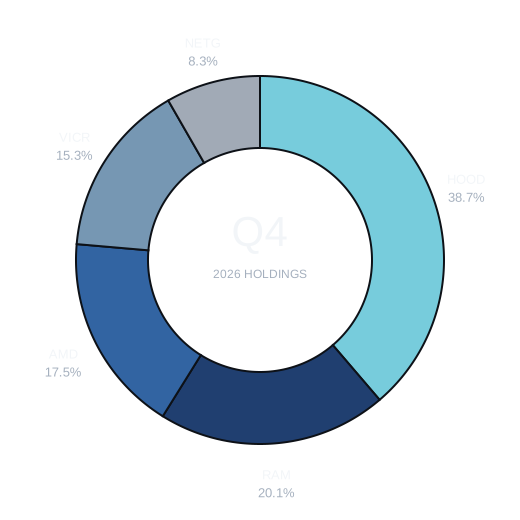
Open positions confirmed October 21, 2026. Estimated purchase-cost allocation across the six recorded buys; not current market-value weights or investment returns. HOOD combines two separate purchases.
Read Q4 snapshot & methodologyEstimated purchase-cost weights · cash excluded. Entry times are shown as reported. All five positions remain open; no exit dates recorded.
| Position | Weight |
|---|---|
| HOODRobinhoodEntry · Oct 14, 12:52 p.m.Separate buy · Oct 14, 1:04 p.m. · Robinhood | 38.7% |
| RAMRoundhill T-REX · DRAM daily 2× ETFEntry · Oct 16, 2:03 p.m. · Robinhood | 20.1% |
| AMDAdvanced Micro DevicesEntry · Oct 14, 12:52 p.m. | 17.5% |
| VICRVicorEntry · Oct 16, 1:00 p.m. | 15.3% |
| NETGLeverage Shares · NET daily 2× ETFEntry · Oct 20, 2:29 p.m. · Robinhood | 8.3% |
Weights rounded to one decimal; chart geometry is normalized. First-broker HOOD and AMD costs use the supplied order-screen estimates, with purchases confirmed by the owner. Fees are not included.
Share of total gain by sleeve.
Portfolio Review, slide 2 · September 4, 2026.
Contribution shares are rounded in the source and may not sum to exactly 100%.
The review found that some of the strongest percentage returns came from smaller positions. Selection and capital allocation told different stories.
Daily-reset leveraged ETFs featured in the book. Their holding-period outcomes do not simply equal twice the underlying return.
The review records roughly 47% average cash weight and a move to 100% cash by September 4 close, ahead of the CPI and FOMC window.
Source: Percentage Review ↗ · September 4, 2026
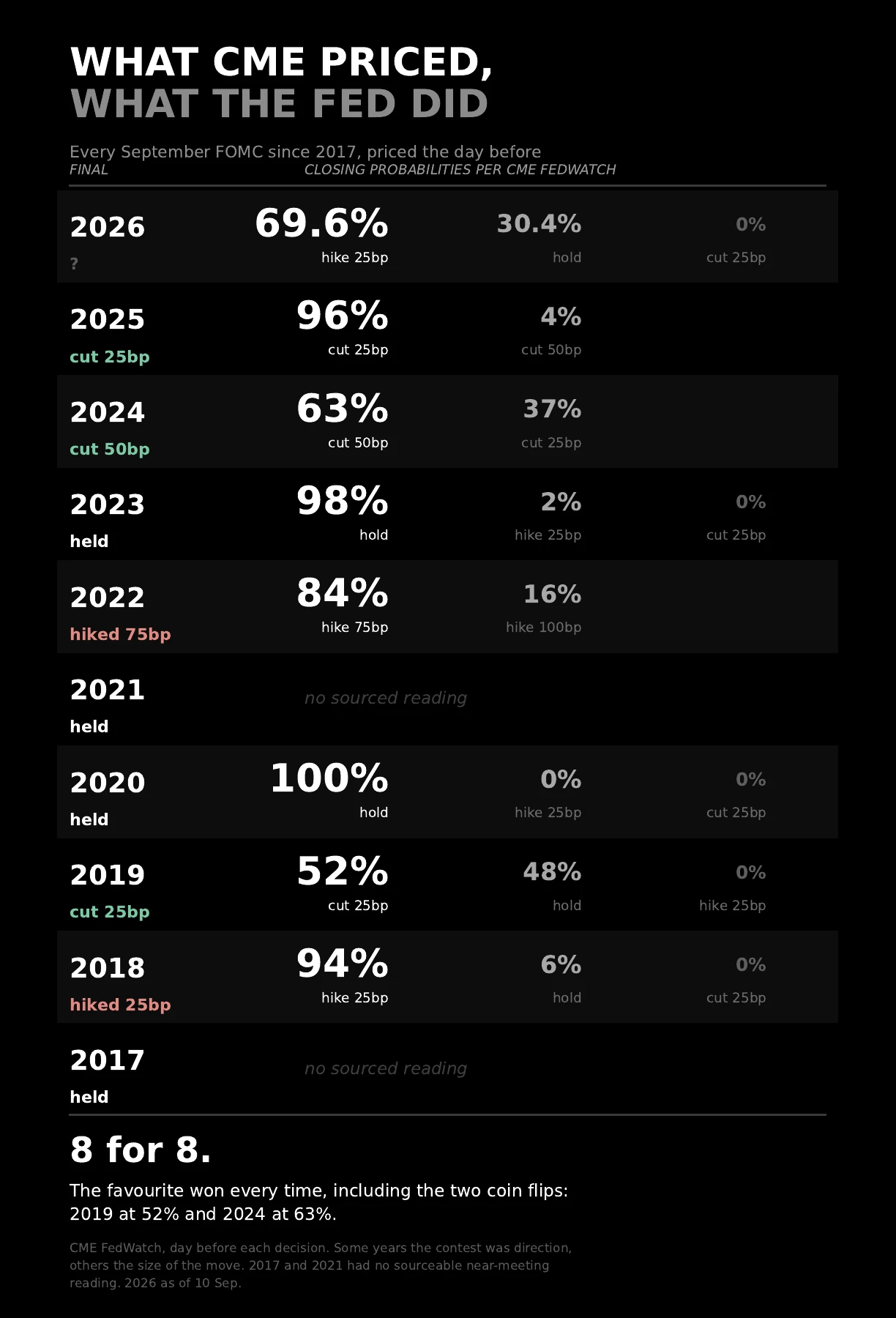
A record of September FOMC expectations and decisions, kept alongside the investment review as context for the cash decision.
Historical document, preserved as supplied. Its 2026 outcome is unresolved in this snapshot; 2017 and 2021 have no sourced near-meeting readings. The document’s “8 for 8” headline does not reconcile with the seven completed, sourced comparisons shown.
Read the original noteReview & holdings.